
There were many, many, many bucket list items for me in Japan, but almost nothing was higher – literally – than seeing Mount Fuji.
We decided to leave it towards the end of the trip, for a couple of reasons, but partly because it would be a great way to wind down the trip out in nature. After a full-on couple of weeks in bustling cities, it was the downtime we really needed.
I was worried, to be honest, that we weren’t going to get to see Mount Fuji at all. On our journey from Tokyo to Kyoto, all the mountains were shrouded in cloud, with no chance of seeing Fuji-San emerge. This is how it’s regularly seen (or not seen, as it happens), and friends of mine have literally spent a week in the region and have still never seen it. So for such a highly anticipated part of the trip, I had to temper my expectations accordingly.
This post contains affiliate links. Please note if you buy or book anything through my links, I may earn a little commission that helps keep this site running, at no extra cost to you. Thank you so much for your support!
This post contains affiliate links. Please note if you buy or book anything through my links, I may earn a little commission that helps keep this site running, at no extra cost to you. Thank you so much for your support!
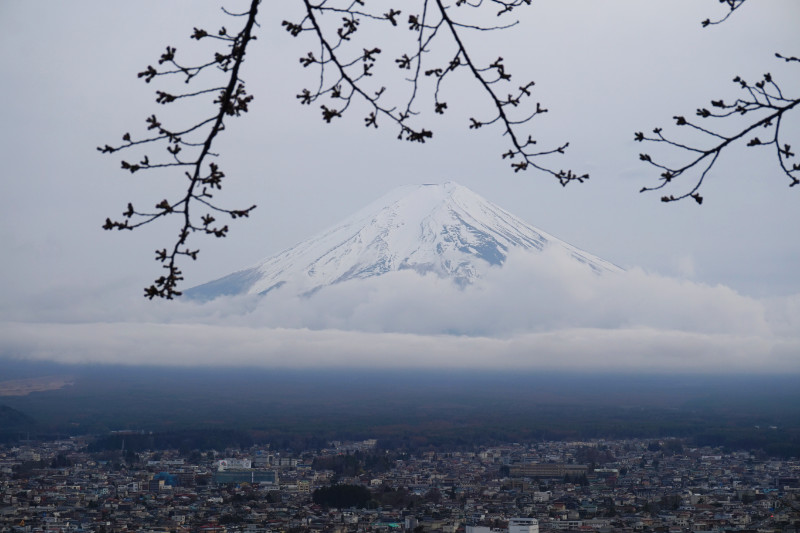
That is kind of how I feel about this post. How can you write a helpful guide on how best to experience Mount Fuji unless you’ve had a fantastic experience yourself? But equally, if you ONLY have a fantastic experience, I don’t think that’s very helpful either as that’s not the norm.
I debated whether I could even write enough for a full post, which is why this is only a semi-helpful guide. My main reason for writing it in the end is because in my research, there was very limited information on how we did it, i.e. visiting from Osaka, and also not a lot about what to expect when Mount Fuji is being temperamental.
And despite our mixed experience, this was undoubtedly one of the highlights of our Japan trip; of ANY Japan trip. I have to write about it, because the first time I caught a glimpse of Mount Fuji from the train, I was genuinely almost in tears, which I don’t think has ever happened to me just from a view. It was only the top poking out of the clouds, and it soon disappeared again, but I didn’t even care – I had seen it!

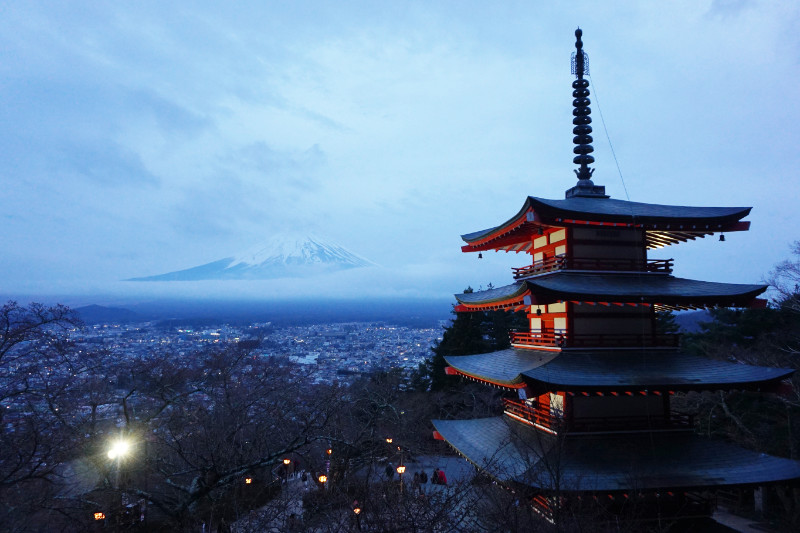
When we turned up at Kawaguchiko, Mount Fuji was still nowhere to be seen, so we headed straight to our accommodation to drop our bags and plan our next moves. The bonus of where we had booked is that it was within walking distance of the famous Chureito Pagoda, the iconic view with Mount Fuji rising in the background. This was my ultimate bucket list photo, so booking somewhere with easy access to it was a priority as it meant we could go if and when Fuji-San decided to show itself.
We were feeling extra pressure too, as unbeknownst to our friend, her boyfriend was planning to propose near the pagoda! Mount Fuji obviously knew this, and appeared right on time.
We headed up around 4pm, which was perfect as it gave us plenty of daylight, although as you can see from my photos it was a dull day, so the lighting was abominable. Again, something to consider when taking photos.

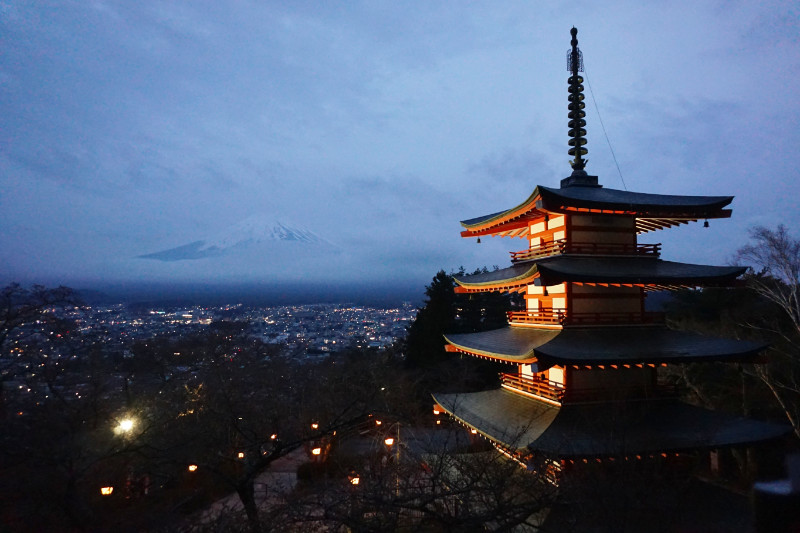
Still so beautiful at dusk!
I will say that visiting at night is great too. I expected Mount Fuji to disappear quickly, but she remained in sight for a long time.
When we woke up the next day and the sun was shining, I was keen to go back up. It’s a bit of a climb to the pagoda, with 400 steps up to it, but the second time felt way easier than the first because I knew there wasn’t much further to go.
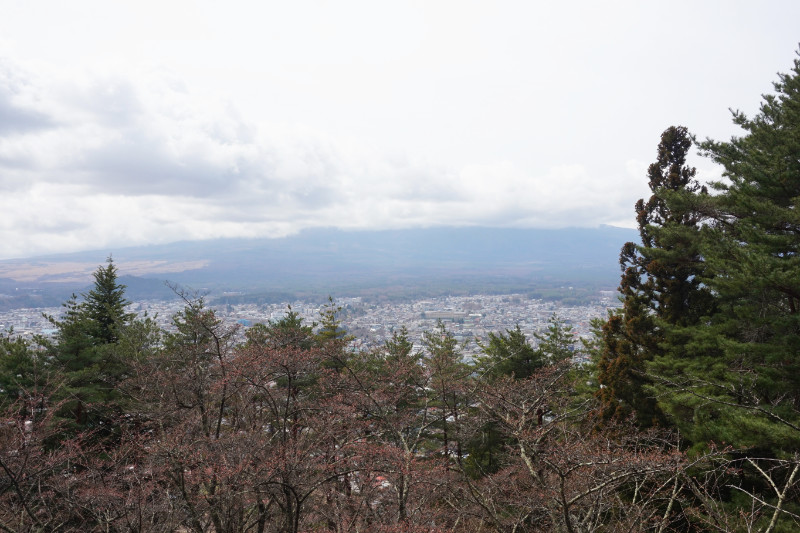
…by the time I got to the top, Mount Fuji had bloody disappeared again!! I just wish I’d left earlier and got up there, but in actual fact it was so busy that there was an hour-long queue to the viewing platform over the pagoda. So it might be that I would never have got that magical shot in the sunshine anyway. Unfortunately, I now wasn’t going to get any shot at all.
I took a quick walk along the paths above the pagoda – if Mount Fuji is showing, the view at the top (the photo above) would be worth it as an alternative to the pagoda shot. Without the views, it wasn’t worth the detour.
This is the view you get of the pagoda from the path directly behind:
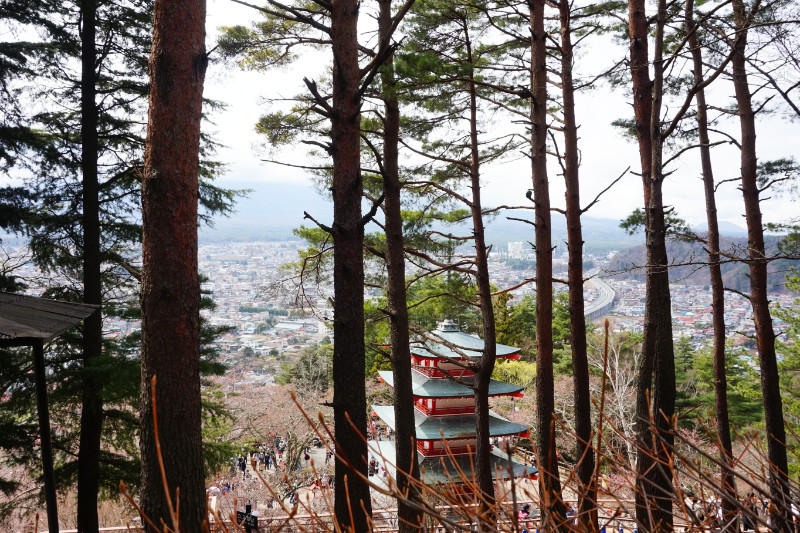
Very obscured. So don’t see this as an alternative.
To be honest, a lot of the photos in this post are simply from the path to the left of the pagoda, and that’s as good a place as any to get photos of Mount Fuji from up there.
AND in the excitement of our friend’s plans the night before, I’d totally forgotten to get a photo of Gulliver! So I specifically took him up the next day and he never got a photo with Mount Fuji, sadly.
(Funny story: you have to cross the train tracks to get from the station to the park. I got a message from a travel journalist I follow on Twitter saying, “I think I just saw you from the train! Were you waiting to cross?” WHAT ARE THE CHANCES?! He said I was the only Western face in the crowd so I stood out, HAHA.)
Tips for visiting Mount Fuji
If there’s one tip I can give for visiting Mount Fuji, it’s that you should spend at least one night there – purely because it maximises your chances of actually seeing Mount Fuji. The downside is that it’s expensive, particularly for the nice ryokans with onsens. Even though we weren’t on a budget, it was still out of our price range, so we opted for something much more budget-friendly instead which I’ve included more info about below. So yes, budget options are available!
I also wanted to be reasonably close to the Chureito Pagoda, so we chose to stay in the Fujiyoshida area rather than Kawaguchiko which is a short train ride away. This was another HUGE advantage of staying overnight, because when we visited in the late afternoon, you could walk straight up to the viewing platform with the famous view. When I went up the following morning, I was faced with the hour-long queue to it. It was insane! I can’t tell you whether it’s always like this, but be prepared for it.

My second tip is to be flexible. This is exactly what a day trip doesn’t give you. When I was up at the pagoda on our second day, I met a couple who had taken one of the day tours. On the way towards Fuji, they’d managed to see the mountain for a lot of the drive, and just as they got to the shrine, it had disappeared again. Because they were on a tour, they wouldn’t be able to stick around, but it especially sucks for people who would have started queuing with an amazing view of Mount Fuji, and by the time they get to the pagoda viewpoint, it’s gone, and that was their only chance.
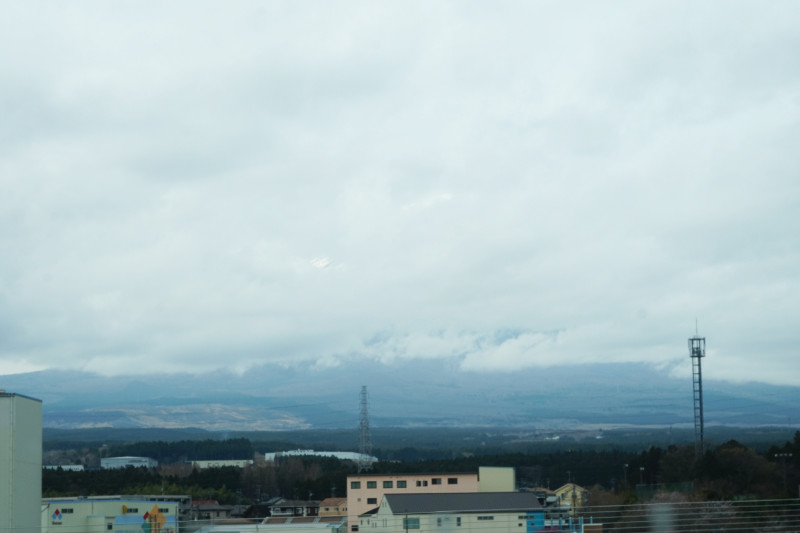
Above: Mount Fuji when we first arrived – if you look VERY closely, you can see glimpses of something in the clouds along the left flank of the mountain.
Below: Mount Fuji about an hour later.
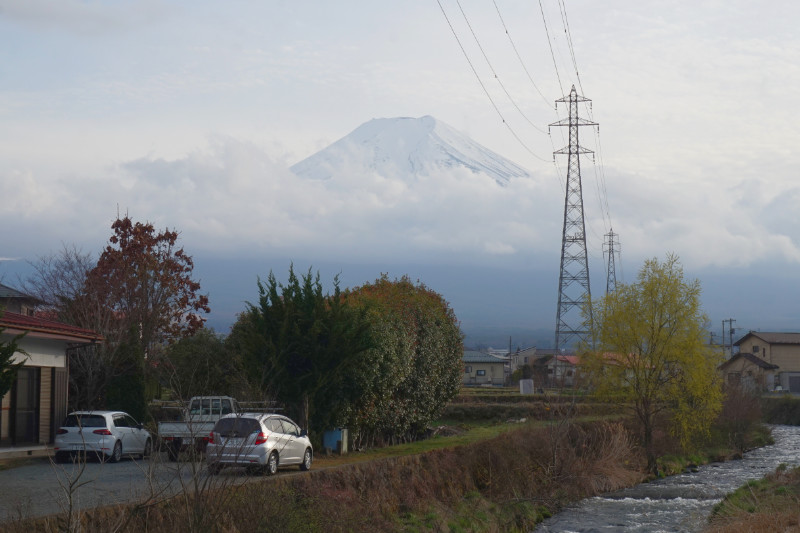
To be honest, seeing this made me so, so grateful for our experience – though I do regret not getting up earlier to get the brighter photos when we DID have the flexibility, and I may even have caught a sunrise, another bonus of staying overnight.
Flexibility also meant that we didn’t spend as long there as we might have done, and this was purely because Mount Fuji had disappeared so we didn’t see the point in trying to find more views of it. I had originally planned to take the bus around Lake Kawaguchiko, or even hire bikes, and stop for various views of Mount Fuji around it. With the Five Lakes nearby, you could easily spend days exploring with even more views.
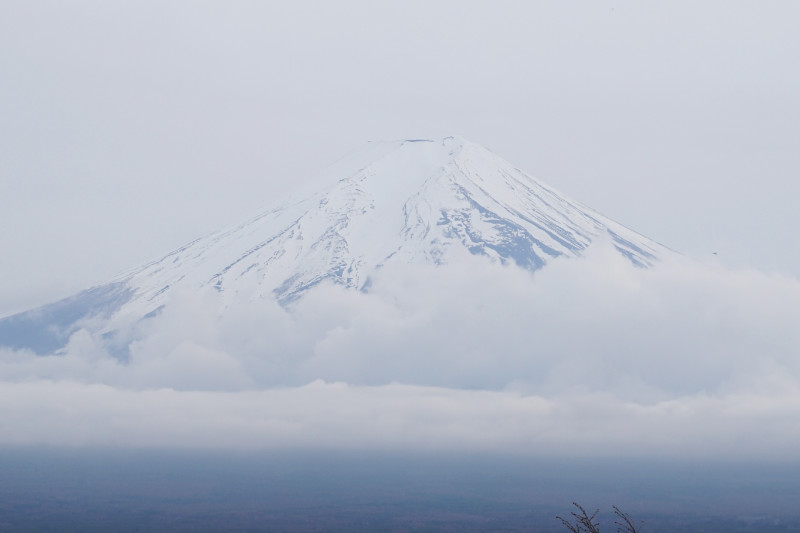
But it is impossible to plan for weather at the best of times, let alone somewhere as temperamental as a shy volcano. We could have wasted the day living in hope, but it wasn’t meant to get better, so we headed onward to Tokyo instead. And you know what? Be prepared for that as well.
The time of year will help, too – Mount Fuji is most likely to show herself during the winter months, so we were on the cusp of peak season for peak viewing. Apparently November to February is the best time. A couple of weeks after our visit – so mid-April or slightly later – would have been prime cherry blossom viewing time. Because it’s at a higher altitude, it takes much longer for the sakura to bloom here.
Although we did get daffodils instead!

How to visit Mount Fuji from Osaka
We visited Mount Fuji in a slightly different way to most people, which is why I wanted to share how we did it. The vast majority of people will visit from Tokyo, whether it’s to stay overnight in Kawaguchiko or just to visit on a day trip.
Originally we were going to do the same, as it’s certainly the easiest way. But after some research I figured out it was possible from Osaka, so we decided to visit en route back to Tokyo instead.
Here’s how to get from Osaka to Mount Fuji:
- take the shinkansen towards Tokyo, but take one that stops at Mishima
- get a bus from outside Mishima station to Kawaguchiko. This also stops at some of the other Five Lakes of Fuji
- we stayed in Fujiyoshida which was then a couple of stops on the train from Kawaguchiko
You can find information on the bus service here, and book the bus to Mount Fuji here.

My main concern was getting to Mishima to find the bus was sold out, but I was also concerned in case we booked a bus, then went to take the train from Osaka and that was sold out, considering only limited trains stop at Mishima, forcing us to miss the bus. I actually considered renting a car in Mishima, which could have been a good idea as it’s the best way to explore the Five Lakes area really, but in the end I risked booking a bus and turning up for the train.
This worked perfectly – the next train from Osaka was sold out, but there was one not long after which we’d allowed time for. And let me tell you, it’s a good thing I did book the bus, even though I only did it the night before. Despite reading numerous things online that everyone just turns up, and despite the fact there was plenty of availability the night before, when we got to Mishima the next few buses were all booked up and it was chaotic. Once again, like many of my other posts, it’s worth noting that we were there in high season and maybe this isn’t always the case, but is it worth the risk?
Also, one advantage of booking the bus is you get to book the seats – so make sure to choose the left hand side. Not that it mattered on our journey in the end!
Getting the train from Mount Fuji back to Tokyo
From Mount Fuji, it’s fairly easy to get back to Tokyo, although there is one change on the train. You have to take a local train up to Otsuki, and then a JR train straight to Shinjuku, where we’d be staying one more night, so it was really convenient for us.
The trains were all straightforward and we had no issues turning up and getting on the next train. What we did have a slight issue with was the seating on the JR train. Because we hadn’t reserved seats in advance, we just had to take any available seats – which would have been fine, but the system didn’t make sense! All four of us got split up when people got on at later stations even though it seemed like we were sat in available seats, and at one point I was taken through to a different carriage entirely. It was so bizarre. The train wasn’t even full, from what I remember.
Anyway, it was fine – we got back to Shinjuku and reconvened.
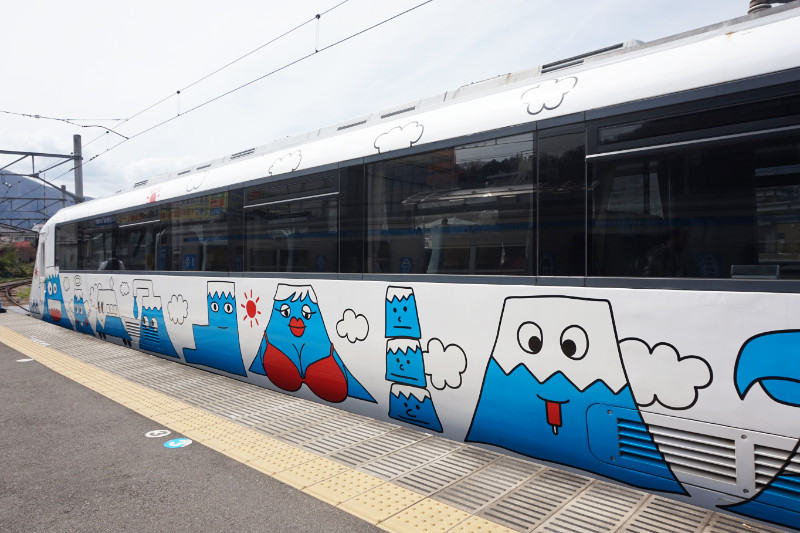
One thing I need to mention is the TRAINS THEMSELVES! We saw so many cool ones around Mount Fuji! As well as the one above, there’s a Naruto one which is because a section of the nearby Fuji-Q theme park is Naruto-themed.
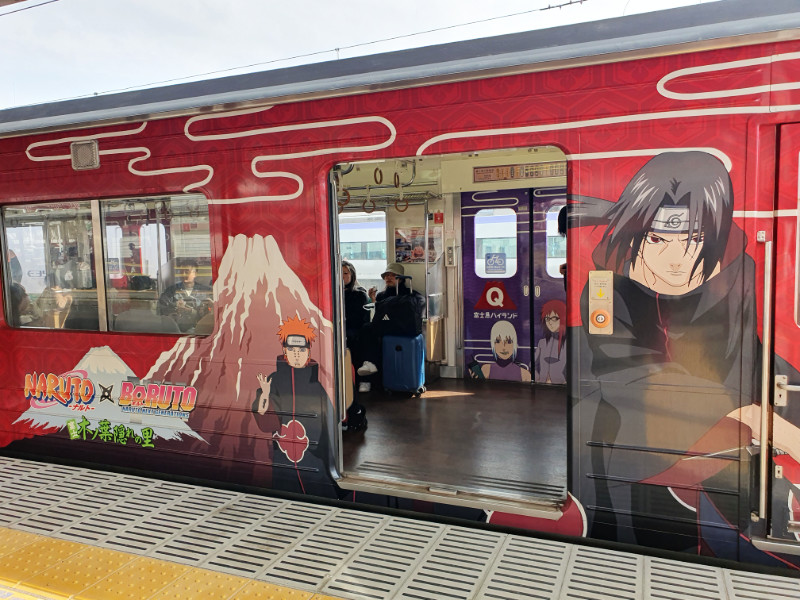
As an aside, Fuji-Q also looks fantastic, but definitely wasn’t a priority for us at this point! Japan has too many great theme parks.
There’s also a Thomas & Friends themed carriage parked up at Shimoyoshida station, and we saw one carriage that looks like kids had drawn astronauts and dinosaurs all over it! So cool. What is it with Japanese trains that is so brilliant?!
Where we stayed – a budget stay in a traditional Japanese house
For a long time, I was tempted to splash out on a hotel with a view of Mount Fuji from our bedroom. In hindsight, this would have been a dream as Fuji-San was on full display first thing in the morning. But what if you pay £300 for a hotel room and never get to see Mount Fuji? It’s a risk we weren’t quite willing to take.
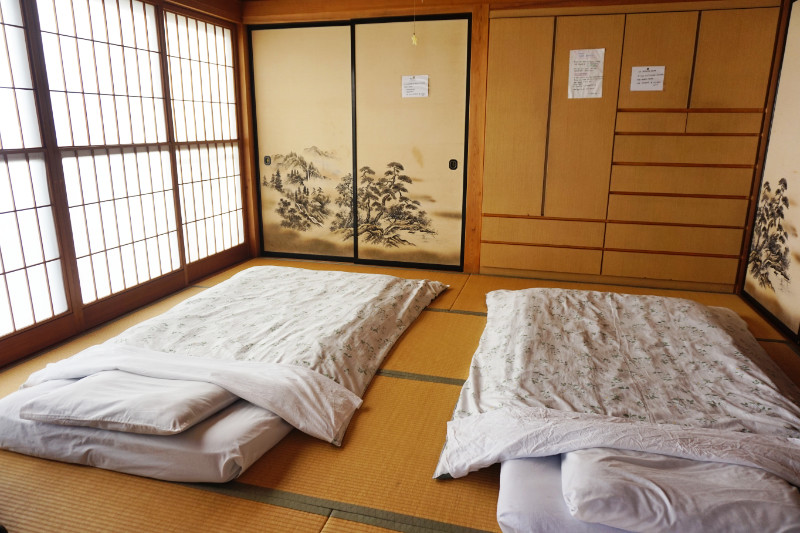
I found this place instead, a highly-rated guesthouse in Fujiyoshida, within walking distance (around 25 minutes) of the Chureito Pagoda. My favourite part about this stay was that we were in a traditional room, sleeping on mattresses on tatami mats with a divider between us. It felt like truly classic Japan! Okay, so it might not have been a ryokan with an onsen, but it was a great experience.
Best of all – it cost £80! Between FOUR of us! Slightly cheaper than the £600 options I’d been looking at.
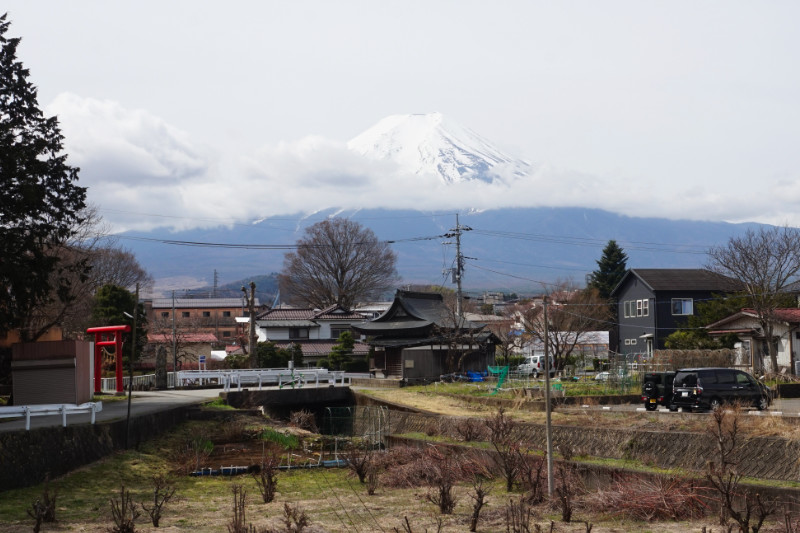
One thing I will say is that Fujiyoshida was very residential with fewer facilities. There weren’t many options for dinner, whereas Kawaguchiko has a lot more going on. In some ways, it’s actually what drew me to Fujiyoshida more anyway, as it just seemed less touristy, despite having one of the most famous attractions in Japan.
It did mean that we never actually checked out Lake Kawaguchi, which was a shame. But, at the end of the day, we got what we went for. We got stellar views of Mount Fuji, and our friends left as an engaged couple! So all in all, it was an extremely successful part of the trip!
We couldn’t have asked for a better way to wind down the final part of our Japan trip. We still had one full day left in Tokyo, which I’ve posted about as part of my main Tokyo post, and then the dream was over.
And Mount Fuji marked the last major travel item on my bucket list… which feels strange to say that my ultimate travel bucket list is complete.
Japan – what a country.
What are some big travel destinations and experiences on your bucket list? I’d love to hear them!
Read more about our Japan trip below:
⭐ Our Perfect Two Week Itinerary For A First Time Visit To Japan
⭐ My Top 10 Highlights Of Our Trip To Japan
⭐ Five Days In The Bright Lights Of Tokyo
⭐ Shrines, Temples & Geisha: How To Spend Two Days In Magical Kyoto, Japan
⭐ A Love Letter To Osaka, Japan: Why It’s Worth More Than A Day Trip
⭐ Hanging Out With The Polite Deer In Nara, Japan
⭐ An Overnight Trip To Hiroshima, Miyajima & Himeji From Osaka
Discover more from An Orcadian Abroad
Subscribe to get the latest posts sent to your email.
Mountains can be so fickle. We have waited days to get a view of certain mountains. Good information for when we someday try to see Fuji. Glad you saw it! Maggie
Absolutely love the daffodils one!
So gorgeous! You were really fortunate to capture the elusive Mt. Fuji during your stay. I didn’t spend overnight there, but even though I was in the area to see it, sadly, I didn’t see the famous mountain (as the tour drove me early in the morning with the fog and all). Certainly a bucket list item to do, for sure! Thanks for sharing, Clazz!
Even more amazing than seeing the reclusive mountain is that someone you (kinda) know may have seen you! I ran into a colleague/acquaintance at Sydney’s Maritime Museum, and my physical therapist was just telling me that he ran into a neighbor recently while vacationing in Hawaii, and neither had known the other was on vacation, much less that they’d gone to Hawaii! So many great small world stories!
Yes!! I love things like that. We actually bumped into one of my childhood friends in Australia, which was amazing! We’d totally lost touch so I’ve got her on Facebook now, and she put me in touch with another old friend too. We’ve also just spent the weekend in Nice and a friend spotted us – we went out for dinner with them last night! What are the chances? 😂
Apparently, the chances are quite good! Haha!
All your research into how to see this elusive mountains seems to have paid off, because that was a great guide on how to see it. 🙂
It looks magical
I love this, and it is very helpful information!
I ran across your blog a year and change later. Thanks so much for sharing your experience, I’m going to be there quite soon, and mass transit will be even more heavily congested than normal. And yeah, accommodations get gobsmackingly dear. I saw some places going for 9k for two nights!